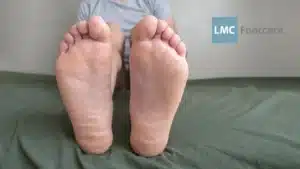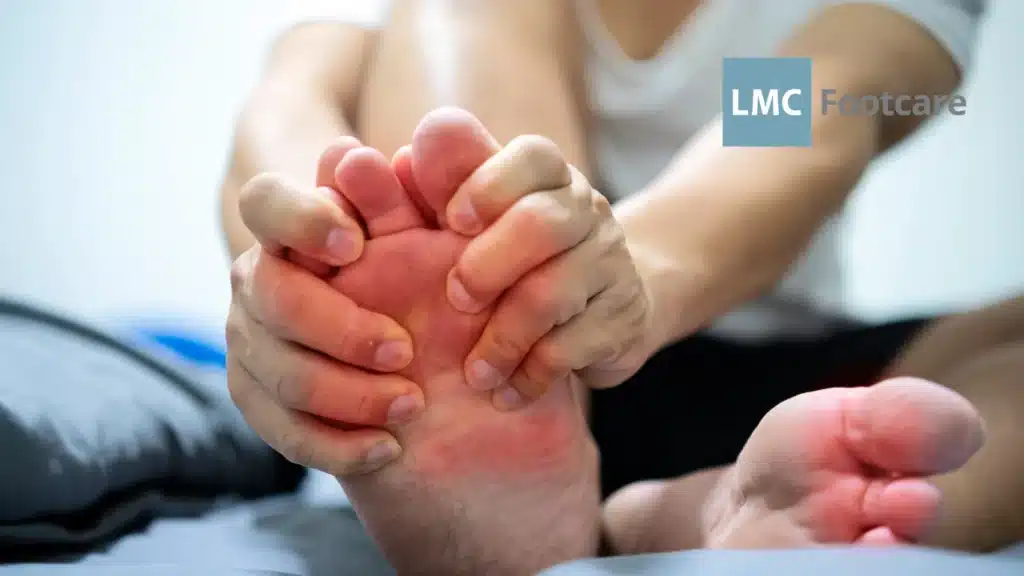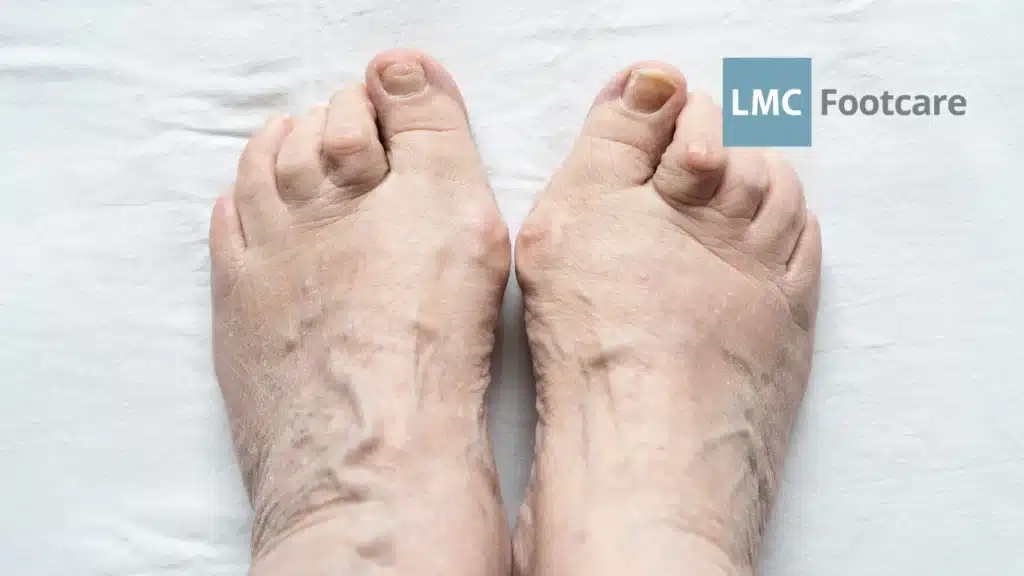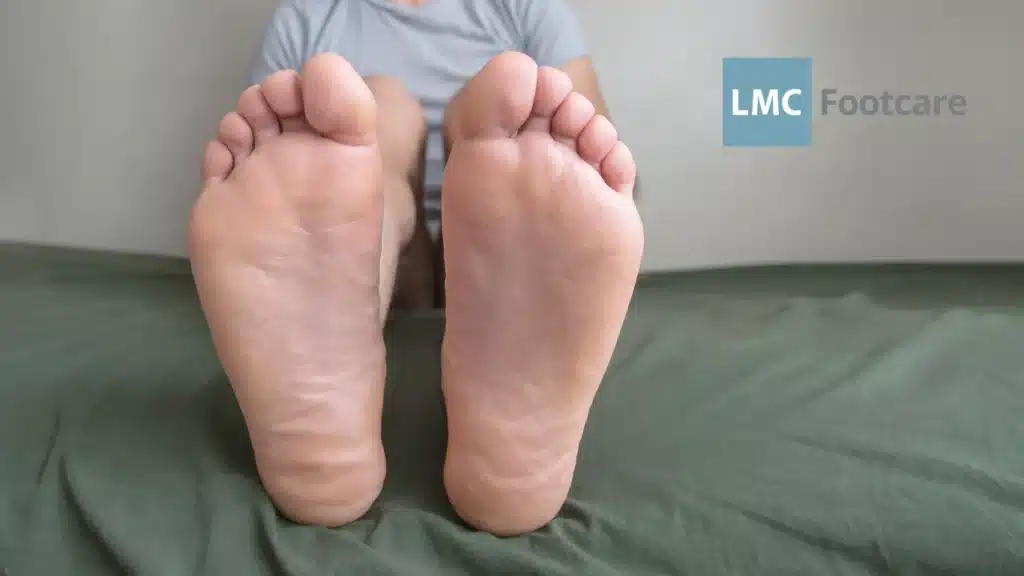


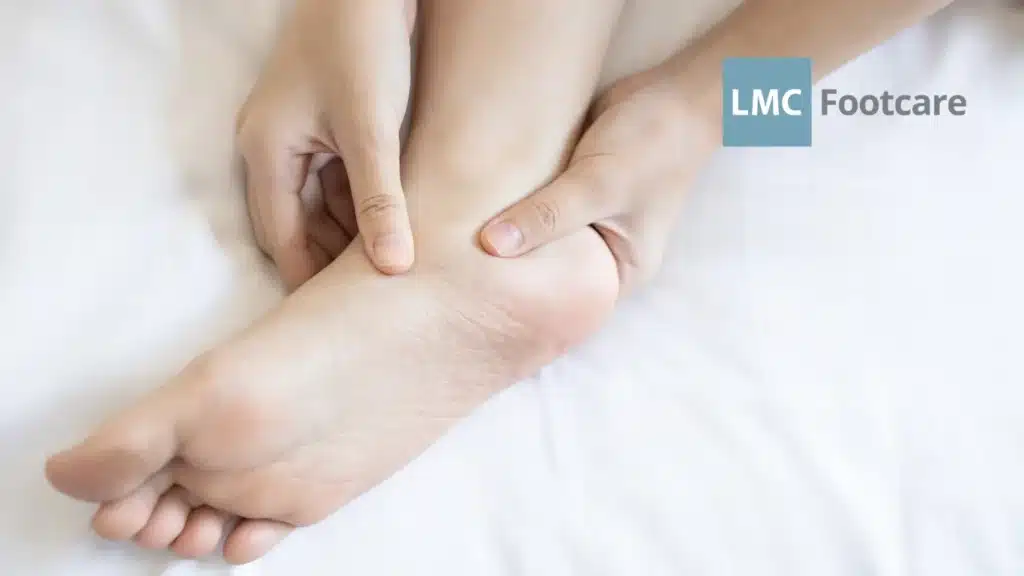
The location, timing, and character of the foot pain are the clearest indicators of what is actually causing it. Heel pain that is worst first thing in the morning points strongly to plantar fasciitis, while burning or tingling in the ball of the foot suggests a nerve issue, and pain across the forefoot after prolonged activity is more consistent with metatarsalgia. At LMC Footcare, our registered chiropodists and Canadian Certified Pedorthists assess foot pain across clinic locations in Ontario to identify the precise cause and determine the most effective treatment, including custom orthotics where a biomechanical issue is identified.
If the Pain Is Under Your Heel: Is It Worst in the Morning?
Yes — sharp pain with my first steps, eases after a few minutes of walking, but returns after long periods on my feet.
This is the hallmark pattern of plantar fasciitis. The fascia — a thick band of connective tissue running from your heel to the base of your toes — becomes inflamed from repeated strain. Overnight, it tightens. The first steps stretch it abruptly, causing sharp pain that eases as it warms up, then returns when the foot is loaded again for extended periods.
What makes it worse: flat feet, tight calves, hard flooring, worn-out footwear, sudden increases in activity.
What helps: calf and plantar fascia stretching, supportive footwear, and custom orthotics that correct the loading pattern causing the fascia to strain repeatedly. At LMC Footcare, our chiropodists and Canadian Certified Pedorthists assess the biomechanical root cause of plantar fasciitis and prescribe custom orthotics tailored to your foot structure and gait — because the same diagnosis rarely has the same cause in two different people.
No — the heel pain is constant, present even at rest, or followed a specific injury.
Constant heel pain or pain that does not follow the plantar fasciitis warm-up-and-return pattern may indicate a stress fracture of the heel bone, nerve entrapment, or referred pain from the Achilles tendon. These require professional assessment to distinguish, as the treatment approach differs significantly from plantar fasciitis management.
If the Pain Is Across the Ball of the Foot: Does It Feel Like Pressure or Like Burning?
It feels like pressure, bruising, or aching — like I am walking on a stone.
This points toward metatarsalgia — excessive pressure on the metatarsal heads, the five bones that form the ball of the foot. The pain typically builds during walking and standing and eases with rest. High arches, flat feet, worn footwear, and forefoot-heavy gait patterns are common contributors. Custom orthotics with metatarsal offloading redistribute the pressure causing this type of pain.
It feels like burning, tingling, or an electric sensation — sometimes between the toes.
This points toward Morton’s neuroma — a thickening of the nerve tissue between the metatarsal bones, most often between the third and fourth toes. Narrow footwear compresses the forefoot and worsens the sensation significantly. Unlike metatarsalgia, removing your shoe and massaging the area often brings temporary relief — a useful distinguishing sign. Treatment focuses on reducing nerve compression through wider footwear, metatarsal padding, and in some cases custom orthotics.
I feel both — aching pressure and occasional burning or numbness.
Both conditions can coexist, and a professional assessment is the most reliable way to identify which is the primary driver and tailor treatment accordingly.
If the Pain Is Under the Big Toe Joint: When Is It Worst?
It hurts most when I push off with my toes during walking or running.
This is consistent with sesamoiditis — inflammation of the two small bones embedded beneath the big toe joint. It worsens with any activity that loads the forefoot and causes a dull-to-sharp pain specifically under the big toe. It is common in runners, dancers, and people who spend extended time on their toes. Custom orthotics with sesamoid offloading — a specific accommodation that reduces pressure directly beneath the affected bones — are central to conservative management.
It came on suddenly overnight and the joint is swollen, red, and extremely tender.
Sudden, severe pain in the big toe joint — particularly when it wakes you from sleep and the area is hot and swollen — is a classic presentation of gout, a form of inflammatory arthritis triggered by elevated uric acid levels. Gout requires medical management rather than orthotic therapy and should be assessed by a physician promptly during an acute episode.
If the Pain Is Along the Inner Arch: Has Your Foot Shape Changed?
Yes — my arch looks flatter than it used to, or my foot seems to angle outward more.
This pattern is consistent with posterior tibial tendon dysfunction (PTTD) — a progressive condition where the tendon supporting the inner arch begins to fail, causing the arch to gradually collapse. The pain runs along the inner ankle and arch and worsens as the day progresses. PTTD is one of the conditions where early orthotic intervention makes the most significant difference to long-term outcomes — once the arch has collapsed significantly, conservative treatment becomes less effective and surgical options may need to be considered.
No — the arch looks normal but aches during and after walking.
Arch aching without visible structural change is more consistent with plantar fasciitis, flat foot strain from overuse, or tight intrinsic foot muscles. A biomechanical assessment distinguishes between these causes and determines the appropriate level of support required.
If the Pain Is Diffuse and Hard to Pinpoint: Consider These Questions
Did the pain start after a significant increase in activity or time on your feet?
Diffuse underfoot pain that follows a period of increased walking, standing, or running is often overuse-related — the foot’s soft tissues are being loaded beyond their current capacity. Rest, footwear review, and a gradual return to activity typically resolve this. If it persists beyond two to three weeks, a biomechanical assessment is worthwhile to rule out an underlying structural issue.
Have you recently changed your footwear?
New shoes — even well-intentioned supportive ones — can alter the mechanics of how your foot loads during walking and create temporary underfoot discomfort. Flat, unsupportive, or significantly worn footwear is a common primary contributor to diffuse foot pain that resolves once the footwear issue is corrected.
Has the pain been present for months despite trying rest and new shoes?
Persistent diffuse pain that does not respond to basic footwear and activity changes almost always has a biomechanical component that requires professional assessment to identify. At LMC Footcare, our registered chiropodists conduct full biomechanical assessments to find what is driving persistent underfoot pain — and prescribe custom orthotics where a structural or mechanical cause is confirmed. Canadian Certified Pedorthists then ensure the orthotic is fabricated and fitted correctly to perform as intended across your footwear and daily activities.
When Should You Stop Trying to Self-Diagnose and See a Professional?
Self-assessment is a useful starting point, but there are clear signals that professional assessment is needed without delay. See a chiropodist or Canadian Certified Pedorthist if your pain has been present for more than two weeks without improvement, if you are limping or changing the way you walk to avoid the pain, if the area is visibly swollen, bruised, or changing in appearance, if you are living with diabetes and notice any foot discomfort, or if the pain is interfering with work, exercise, or daily activity. Early assessment leads to faster recovery and prevents conditions from becoming chronic or structurally progressive.
At LMC Footcare, no referral is required. Our clinics across Ontario — including Toronto and Vaughan — offer comprehensive foot assessments with registered chiropodists and Canadian Certified Pedorthists who identify the precise cause of underfoot pain and build a treatment plan around it. Book at lmcfootcare.ca or by calling 1-844-562-3668.
Frequently Asked Questions
Q: Can the same pain under the foot have more than one cause at the same time?
Yes, and this is more common than people expect. Plantar fasciitis and metatarsalgia can coexist in the same foot, as can Morton’s neuroma and metatarsalgia. Biomechanical conditions tend to create compensatory loading patterns that affect multiple structures simultaneously. A professional assessment identifies all contributing factors rather than treating just the most obvious one.
Q: I have had this pain for years and assumed it was just normal. Should I still get it assessed?
Absolutely. Chronic underfoot pain is not normal, and many people live with it for years under the assumption that nothing can be done. In the majority of cases, a biomechanical assessment identifies a treatable cause — and custom orthotics, footwear changes, or targeted treatment produce meaningful improvement even in longstanding cases.
Q: Will custom orthotics help regardless of which condition I have?
Custom orthotics are effective for most underfoot pain conditions that have a biomechanical component — which includes plantar fasciitis, metatarsalgia, sesamoiditis, PTTD, and flat foot strain. They are less relevant for conditions like gout or acute stress fractures, where medical management takes priority. A chiropodist at LMC Footcare will confirm whether orthotics are appropriate for your specific diagnosis before prescribing them.
Q: Is underfoot pain during walking always a foot problem, or could it come from somewhere else?
Most underfoot pain originates in the foot itself, but referred pain from the lower back, hip, or knee can sometimes manifest as foot discomfort. A comprehensive biomechanical assessment considers the full lower limb rather than the foot in isolation, which is why professional assessment is more reliable than self-diagnosis for persistent or unusual pain patterns.
Q: How quickly can I expect results after starting treatment for underfoot pain?
Many people notice improvement within two to four weeks of starting treatment, particularly once footwear is corrected and custom orthotics are in place. More chronic or structurally complex conditions may take longer to respond fully. Follow-up appointments at LMC Footcare allow the treatment plan to be adjusted based on how the foot is responding, ensuring the most efficient path to recovery.